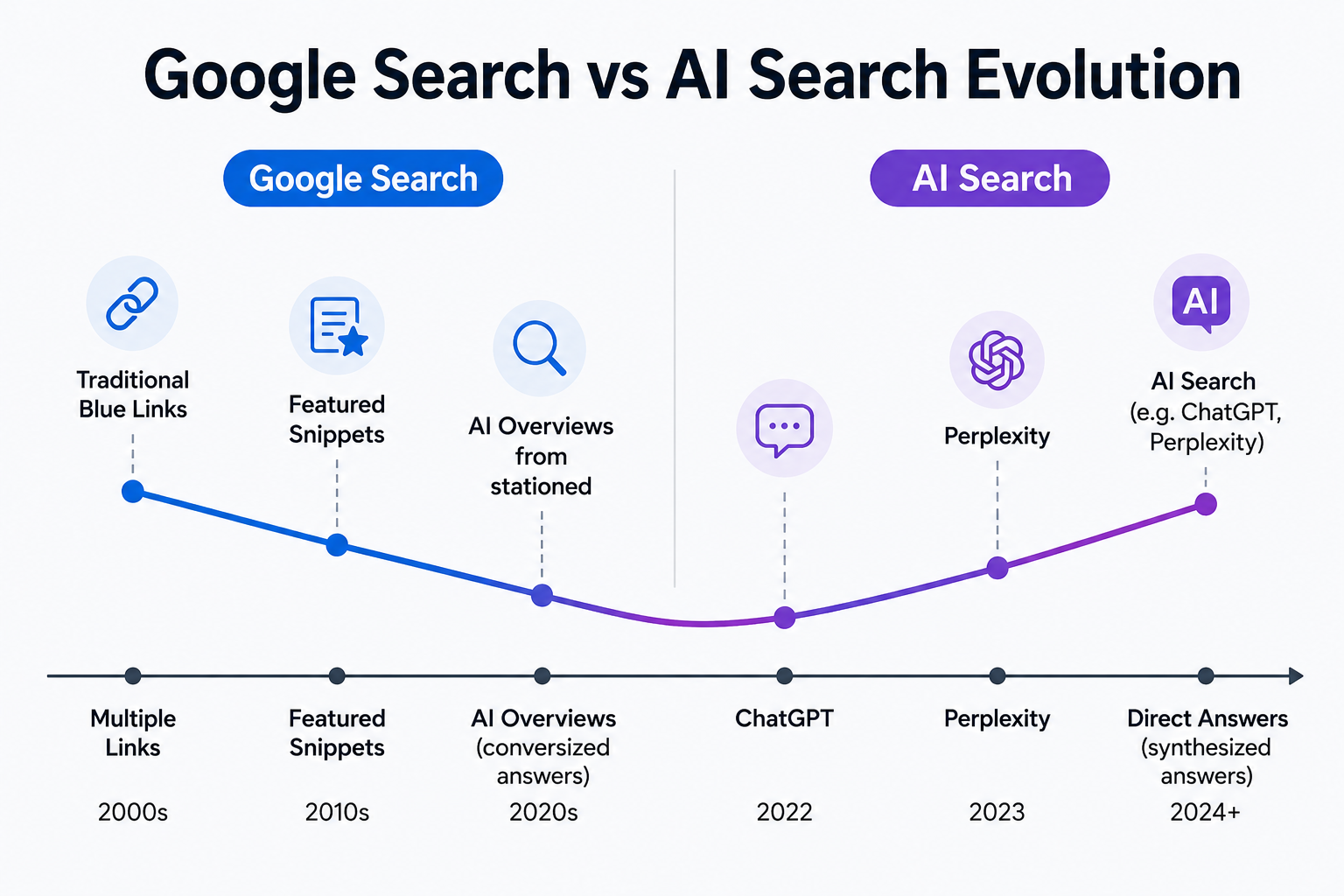
AI Search Optimization: Google Search vs AI Search Evolution
AI Search Optimization is transforming the way people search for information online. Instead of scanning through a list of links, more and more users are simply asking AI assistants like ChatGPT or Perplexity a question—and getting a direct answer.
Why AI Search Optimization Matters for Businesses
The way people search for information has fundamentally changed. Instead of scanning through a list of links, more and more users are simply asking AI assistants like ChatGPT or Perplexity a question—and getting a direct answer.
If you run a business, this shift matters. A lot.
When someone asks “What’s the best CRM for small businesses?” or “Which digital marketing agency should I work with?”, the AI doesn’t show ten websites to browse. It gives a recommendation. And if your business isn’t part of that answer, you’re essentially invisible to a growing segment of internet users.
This guide breaks down what’s actually happening, what you can do about it, and how to position your business for this new search landscape.
What’s Changed About Search
For years, SEO was about ranking on Google’s first page. You optimized for keywords, built backlinks, and hoped your snippet looked clickable enough.
That game is still running—but there’s a new one happening alongside it.
AI-powered search engines don’t work the same way Google traditionally does. They don’t rank pages. They synthesize answers by pulling from multiple sources and generating a response. The goal isn’t to send you to a website; it’s to give you the answer directly.
This means the question for businesses is no longer just “How do I rank higher?” It’s now also “How do I become the answer?”
The Difference Between Traditional SEO and AI Search Optimization
Let’s clear up the confusion, because these two things overlap but aren’t identical.
| Traditional SEO | AI Search Optimization |
|---|---|
| Focuses on ranking in search results | Focuses on being mentioned inside AI-generated answers |
| Keywords and backlinks are central | Context, authority, and trustworthiness are central |
| Users click through to your site | Users may never visit—your brand is cited directly |
| You optimize for search engine crawlers | You optimize for language models that understand meaning |
Here’s the key insight: you need both. Traditional SEO helps you rank. AI search optimization helps you get mentioned. They complement each other.
How AI Search Engines Decide What to Recommend
AI models like ChatGPT don’t have a secret ranking algorithm you can reverse-engineer. But they do have patterns in what they tend to trust and cite. Based on how these systems work, here’s what seems to matter:
1. Topical authority
If your website consistently publishes in-depth, helpful content about a specific subject—say, CRM implementation for small businesses—AI systems are more likely to see you as a credible source on that topic.
2. Structured, clear information
Content that’s well-organized with clear headings, bullet points, FAQs, and direct answers is easier for AI models to parse and quote.
3. Brand presence across the web
AI models don’t just read your website. They’re trained on data from across the internet—forums, news sites, social media, directories. If your brand is mentioned positively in multiple places, that builds trust.
4. Conversational, human-sounding content
Keyword-stuffed, robotic writing doesn’t help anymore. AI systems are trained on natural language, so content that reads like one human explaining something to another performs better.
5. Original insights and data
Unique statistics, case studies, frameworks, or research give AI something to cite. Generic information that exists everywhere won’t stand out.